

Brain Injury Awareness Month: Understanding Invisible Brain Injuries

Every March, Brain Injury Awareness Month shines a spotlight on one of the most misunderstood and under-recognised health challenges in modern medicine.
Brain injuries are often referred to as the “silent epidemic.” They affect millions of people worldwide each year, yet many remain undiagnosed because their symptoms are invisible and conventional scans frequently appear normal.
At Innovision IP, our mission is to help change that.
The Silent Epidemic of Brain Injury
Brain injury is one of the leading causes of death and disability in people aged 1–40. While severe traumatic brain injuries are usually identified quickly, many mild traumatic brain injuries (mTBI) go undetected.
Common causes include:
Road traffic accidents
Sports injuries
Falls
Assaults
Military service or blast exposure
For many patients, the physical injury may occur in seconds — but the symptoms can last for years.
These symptoms can include:
Memory problems
Difficulty concentrating
Headaches
Fatigue
Sensory sensitivity
Mood changes
Cognitive impairment
Yet despite these very real symptoms, many patients are told that their MRI or CT scan
appears “normal.”
Why Brain Injuries Are Often Missed
Traditional imaging techniques such as CT and standard MRI scans are excellent at identifying major structural damage like bleeding or swelling.
However, they are often unable to detect microscopic abnormalities caused by mild traumatic brain injury.
This leaves many patients caught in a frustrating situation:
They know something is wrong — but there is no visible evidence on conventional scans.
Without objective data, it can be difficult for clinicians to confirm a diagnosis or determine the most appropriate treatment pathway.
Innovision IP: Revealing the Invisible
At Innovision IP, we specialise in detecting brain injuries that traditional imaging methods frequently miss.
Our advanced approach combines:
Magnetoencephalography (MEG)
MRI neuroimaging
High-performance computing
Proprietary AI analysis
By comparing an individual brain scan against large databases of healthy controls, we can identify subtle abnormalities that indicate brain injury.
This process enables us to:
✔ Detect microscopic brain abnormalities
✔ Provide objective evidence of injury
✔ Support clinical decision-making
✔ Help guide treatment and rehabilitation pathways
For patients who have struggled to find answers, this technology can provide much-needed clarity.
A Faster, More Accurate Analysis
Another key advantage of Innovision’s approach is speed.
Using high-performance computing and AI-driven analysis, we can significantly reduce the time it takes to interpret complex neuroimaging data while also improving accuracy.
Patients attend a half-day, non-invasive assessment, and within approximately three weeks, both the referrer and the patient receive a detailed report outlining the findings.
This report can then help clinicians better understand the injury and determine the most effective next steps in treatment.
Why Brain Injury Awareness Month Matters
Brain Injury Awareness Month is not only about recognising the impact of brain injuries — it’s also about ensuring that people receive the diagnosis, understanding and support they deserve.
Raising awareness helps:
Encourage earlier diagnosis
Improve access to specialist care
Support research and innovation
Reduce stigma around invisible injuries
Most importantly, it reminds people experiencing unexplained symptoms that they are not alone — and answers may exist.
Looking Ahead
As awareness grows, so does the importance of advancing diagnostic technology.
At Innovision IP, we remain committed to helping uncover the hidden effects of brain injury and providing the objective evidence needed to support patients, clinicians, and treatment pathways.
Because when brain injuries are invisible, technology must make them visible.
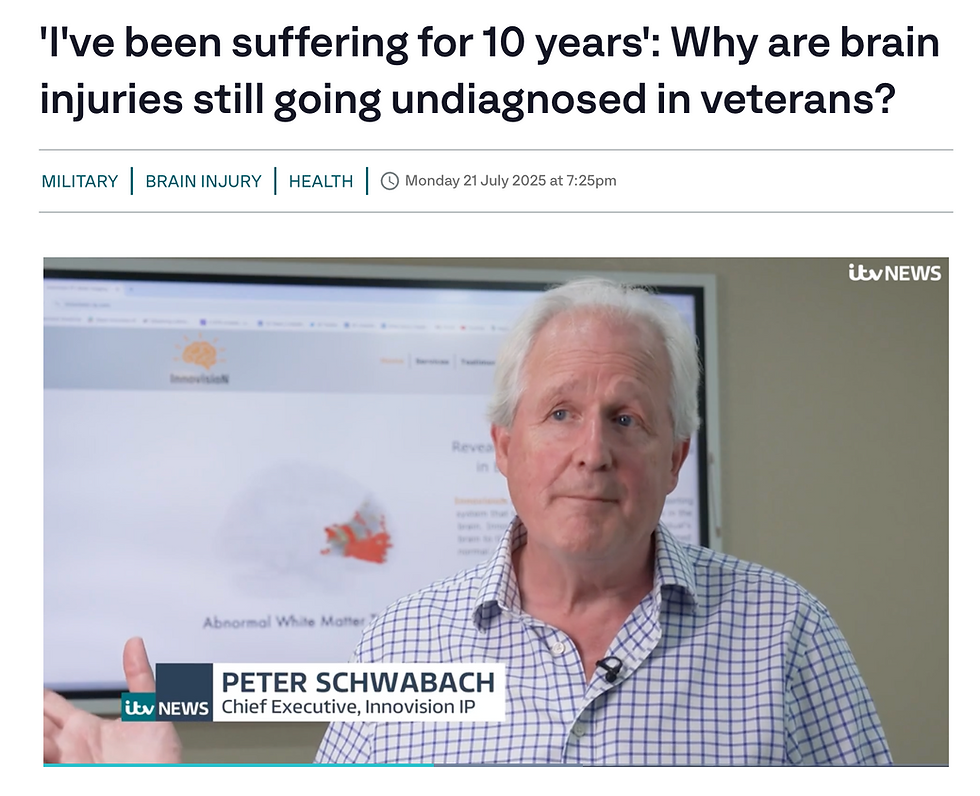


This article demonstrates how developments in radiology are increasingly connected with artificial intelligence and computational analysis. The combination of advanced imaging and data analysis could become an important direction for improving the evaluation of complex neurological conditions.